

A few weeks ago I was dragged on Twitter after I casually mentioned that I had updated my timelines to be more like 2030, and that at the time of publication of AI 2027 my median was 2028. For more on that whole thing, see this thread. https://x.com/DKokotajlo/status/1992316608073847201
This note is a ramble that I wrote to myself that day in frustration, potentially planning to turn it into a tweet thread or blog post but ultimately deciding against it. I’m posting it here since some may be interested in it. Basically it explains more about the history of AI 2027 and my views on timelines and how they’ve changed over time.
Thoughts, in no particular order:
Meta: Why make quantitative predictions at all, when the truth is you don’t know? Answer: (A) because it’s good for collective epistemics if people who disagree quantify their disagreements and make them falsifiable and concrete. This helps avoid the natural human tendency for everyone to conclude that the latest events confirm what they’ve been saying all along. (B) because forcing yourself to make a concrete quantitative guess is just an excellent prompt in general for getting yourself to understand a space better. It does wonders for cutting down on wooly thinking and it forces you to prioritize the questions that matter most–e.g. “Will the METR trend go superexponential eventually, or nah?” matters a ton, “How should we update based on GPT-5?” doesn’t matter much at all (it’s just one data point).
First, the history of my all-things-considered views over time:
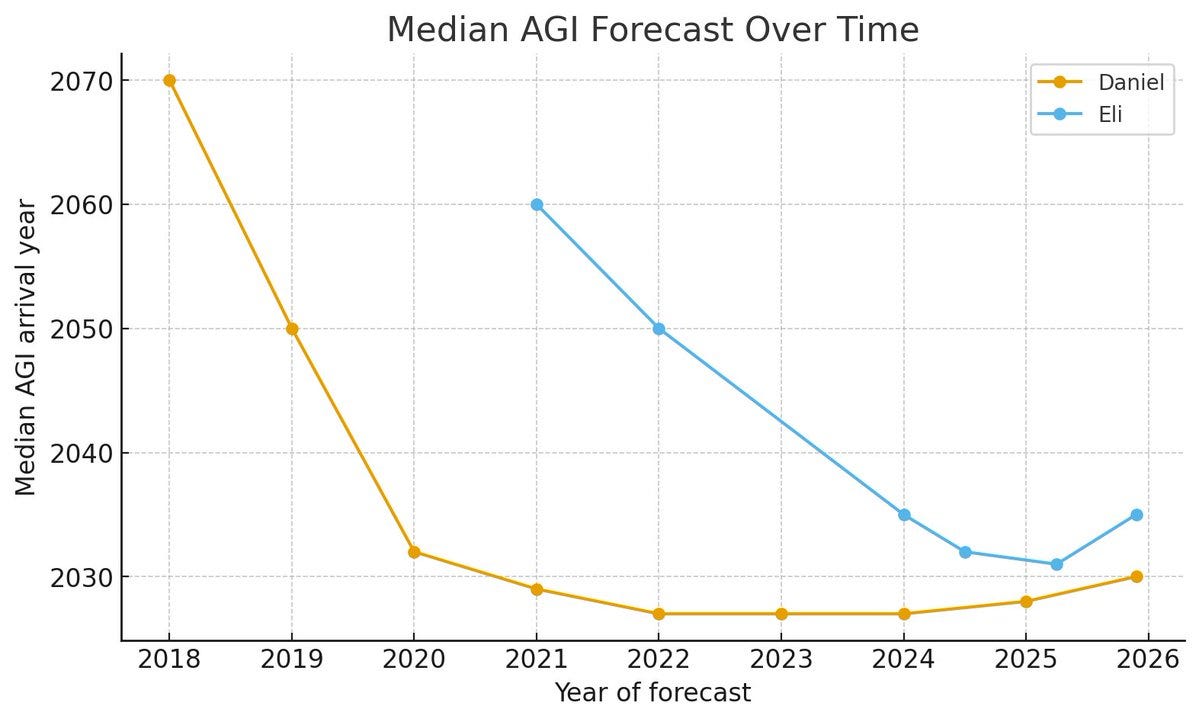
The part you may be interested in now is what I was thinking in 2024 as we drafted AI 2027. There were many considerations, but if I have to summarize them, it was basically: “Already in 2021 or so we had decent reason to have something like 2030 as modal year, and progress has been quite fast since then, and various researchers in the companies seem to really think we are just a few years away. And it seems that all the benchmarks will saturate, like, by 2026 or so. Of course, there’s a famous gap between benchmark performance and real world performance – most notably, AIs can crush graduate-level Q&A questions in basically every field, yet they can’t hold down a job for any significant length of time even if it’s a very basic job like managing a vending machine. On a technical level, there’s a pretty plausible explanation for the pattern of performance we are seeing on benchmarks vs. real world jobs: Agency skills. The AIs suck at operating autonomously for long periods in pursuit of goals. Why do they lack agency skills? Well, maybe because they basically haven’t been trained to be agents basically at all yet. But now the companies are just beginning to do that…
The others on the team basically thought all this was plausible but put more weight on longer-timelines scenarios than I did. Things tend to take longer than insiders expect, the benchmark-to-real-world gap is probably bigger than I thought, they said, for example. But they still liked the idea of publishing an AI scenario, and since it was my project I was boss, plus also 2027 was roughly their modal year if not their median year.
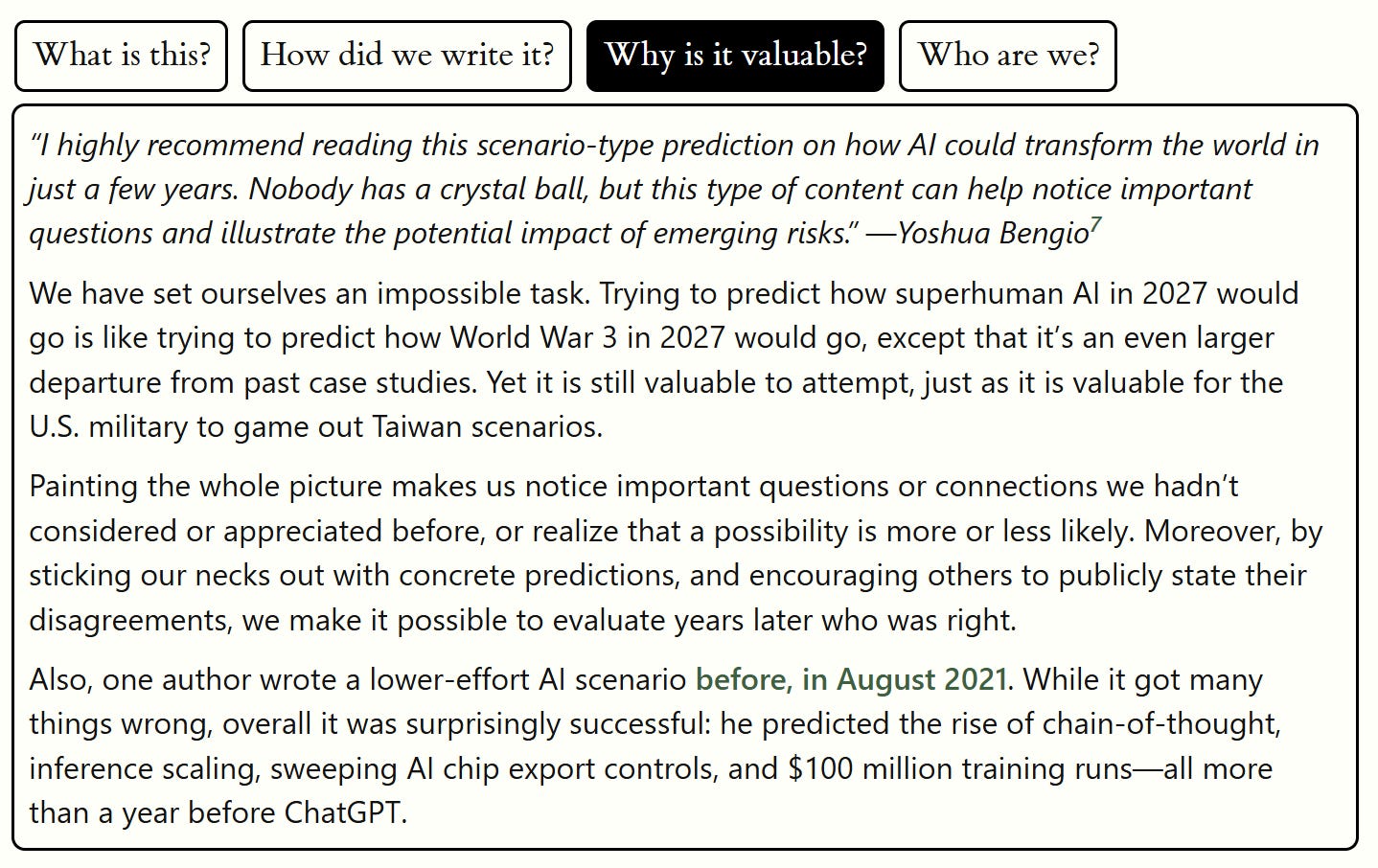
Context: The point of AI 2027 was not then, and never was, “AGI is coming soon aaah we need to tell everyone AGI is coming soon.” If that was our goal we would have focused more on the timelines model, on explaining our overall views about timelines (which go beyond the model), and less on the scenario. The point of AI 2027 was to be concrete and specific about what the path to AGI might look like, how it might go, with all the geopolitical dynamics etc. It was a response to e.g. Situational Awareness which we thought was pretty great overall but didn’t go far enough in terms of building up a clear coherent scenario. (Lots of vague question marks at the end of SitA about what happens when the US ‘wins’ the race and what that even looks like etc., for example). The messaging on the front page of AI 2027 reflects this; see the section “Why is it valuable?”
Then, by early 2025, we were getting close to completing our scenario. We also had a writeup of our core timelines model (the benchmarks+gaps) which was our main attempt to quantify the various considerations and convert them into actual numbers. Also the METR trend dropped, which was actually an update towards longer timelines for me. This model, plus the METR trend, plus our various internal discussions, had convinced me that 2027 was probably too soon; I shifted back my median to 2028. We incorporated the METR trend into our model; we had a dispute about whether to use an exponential or superexponential extrapolation for it; our model put some weight on both therefore. (Happy to explain more about this dispute but skipping over it in the interest of time). Also, at the time the METR downlift study wasn’t out yet, and various other uplift studies + talking to friends at AI companies seemed to suggest that we were already getting serious uplift (e.g. 20%) from today’s AIs, which indicates that maybe we don’t have that much farther to go on the METR trend before things start massively accelerating.
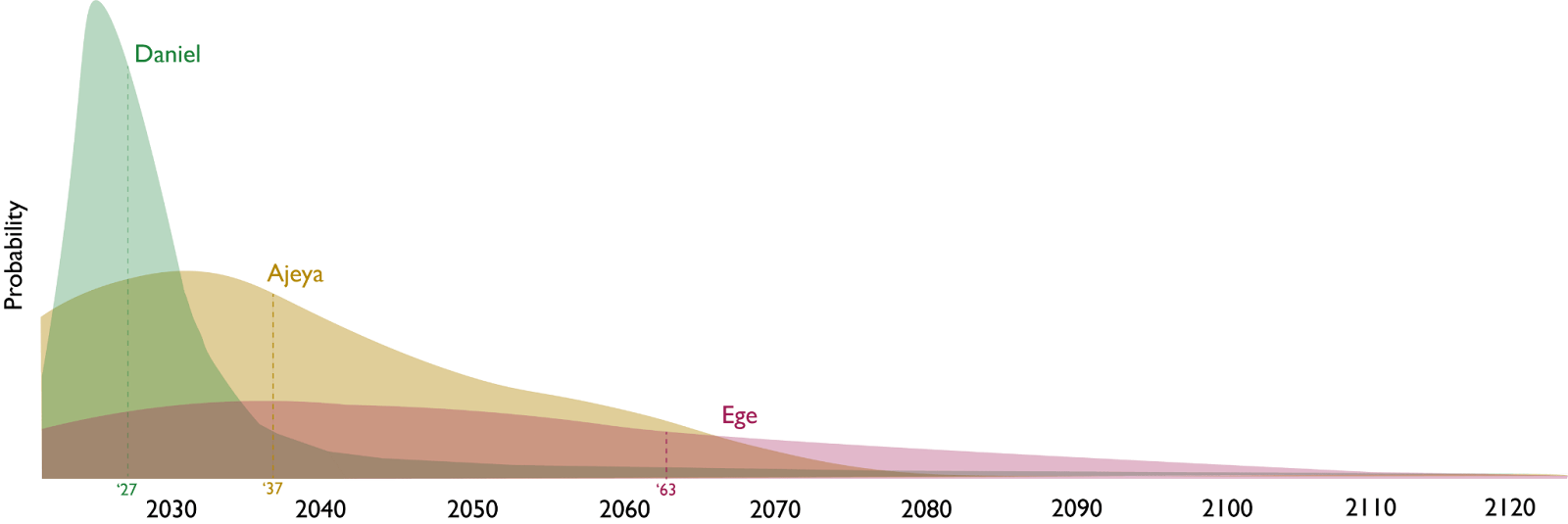
In case it isn’t clear, all this focus on medians is just because it’s a handy summary statistic to talk about when one is trying to be quantitative. Don’t forget that the state of my actual uncertainty is huge error bars ranging from “dear god for all we know the AI companies made a breakthrough yesterday and they haven’t announced it” to “Maybe this is a bubble that’ll pop and deep learning will hit a wall and we won’t get AGI for decades.” On occasion in the past I’d make probability density functions such as this one which are more informative than a summary statistic:
Also, you may be wondering what the other authors of AI 2027 were thinking at this time. I’ll let them speak for themselves if they want, but basically they were mostly following Eli in thinking that things would probably take a few years longer. Eli’s median was 2031 at this time, down from 2032 a bit before.
Then we published AI 2027! At the time we published, it was something like our aggregate modal scenario, though my median was a bit longer (2028) and the other authors’ medians were a bit longer still (e.g. 2031). We didn’t want to rename the scenario because e.g. “AI 2028” or “AI 2031” would be an inaccurate name for the scenario; in the scenario, AGI and superintelligence both happens in 2027. I wanted to call it “What superintelligence looks like” but it was thought that this was too long and not memorable. In general we didn’t realize the extent to which people would anchor on the specific year; the specific year is one of the least interesting things about our scenario in our opinion and wasn’t the point of it. Partly this is because of how big it blew up – we didn’t expect it to be nearly this big. (We actually made predictions beforehand of how many views it would get, and this was like a 90th-percentile outcome on that metric! We can therefore quantify exactly how surprised we were!) It’s become a sort of cultural phenomenon and as a result there is a huge swath of people who have heard about it but haven’t actually looked at it, or who looked at it but didn’t read it. And the % of people who read the footnote clarifying the relationship between the scenario, our medians, and our modes, was of course smaller still. We do feel bad about this and wish we could go back in time and fix this somehow. We did in fact add a disclaimer about this on the front page of AI 2027.
Also, separately, our timelines have shifted out a bit since publishing AI 2027. There isn’t one single reason for this, it’s a bunch of little things adding up:
METR downlift study came out, which was an update to us that maybe AI isn’t accelerating things already as much as we thought, which makes it more plausible that we have still a long way to go before AI accelerates things a lot.
More AI models were released by various companies, and the capabilities of said models, while impressive, were not as impressive as we expected. For example these new data points on the METR trend were somewhat below our median forecast. (Isn’t it good that we made concrete falsifiable forecasts instead of just being vague? Now reality can slap us in the face and make us update!) [EDIT: Apparently it was actually pretty close to what our timelines model predicted, nevermind. But it was below what our widely-retweeted graph said. For other benchmarks, SWEBenchVerified scores are like 81% now compared to our forecast 85% iirc, and OSworld is doing pretty closely. We’ll try to make a blog post before New Years going over the various predictions in AI 2027 and how they’ve fared so far.]
We continued thinking about timelines & improving our timelines model; our new model (mostly done by Eli and Brendan) is significantly better in our opinion than our old one (though, to be clear, no AGI timelines model is particularly trustworthy on its own, this is an inherently difficult thing to predict and the field is young). The new model continues in the same tradition as the old one, it has roughly the same shape, but it takes more factors into account, uses somewhat more empirical data, and in general has had more thought put into it. We’ll release it in the coming weeks along with a blog post explaining how it works & how it compares to other models and methods of forecasting AI timelines. And the new model gives somewhat different (and longer) timelines than the old one. [EDIT: There are a bunch of reasons for this which we’ll explain in the post. Overall the empirical evidence has been less of an update for me than the improvements in the model; the predictions were off but not by THAT much.]
I love it - clear thinking (despite the difficult domain), transparency and honesty about updates!